

As I’ve mentioned to y’all in earlier posts, 2023 has been about inhaling, thinking about, and celebrating words – in articles, emails, songs, poetry, posts, quotes, books, and the list goes on and on. I can’t get enough of them. I mean, can you even imagine how many words we haven’t read or heard in our lifetimes? On the On Being podcast, Krista Tippet interviewed Reid Hoffman about AI and Chat GPT-4. He said that Chat GPT-4 was trained on two trillion-plus words, which is more than we could read in HUNDREDS of lifetimes. Whoa. Just thinking about that makes me realize how much we can’t physically take in, but it is also inspiring to think how much more there always is to learn. Yay words.
Today, Maria Popova (the person I’d credit with helping me appreciate words more this year) shared an article by Frank Bruni where he listed the “Best Sentences of 2023.” Yay! More words! This was inspiration for me to go back over my year to find some of the best sentences/quotes/poems I discovered this year – the ones that moved and inspired me. I keep them catalogued in my notes tab, saved as jpegs on my desktop, and documented in emails to friends and colleagues. I have many more words to share than the ones I list below– in emails from friends, in conversations with my kids, in speeches I’ve listened to, and I even found a few quotes I wrote down that I have NO idea who said them. So. Many. Words.
I’ll start my list with one of the sentences Frank Bruni used in his article by the one and only, my pretend BFF, Maria Popova. Truth be told, many of the quotes I include on this list, I found on Maria Popova’s website, The Marginalian. I highly recommend subscribing to her newsletter and following her on the socials.
“We were never promised any of it — this world of cottonwoods and clouds — when the Big Bang set the possible in motion. And yet here we are, atoms with consciousness, each of us a living improbability forged of chaos and dead stars. Children of chance, we have made ourselves into what we are — creatures who can see a universe of beauty in the feather of a bird and can turn a blind eye to each other’s suffering, creatures capable of the Benedictus and the bomb. Creatures who hope” – Maria Popova
“And so it’s just one — even in the smallest interaction with a kid, Krista, you can let them know that you absolutely see them there, and with all their intelligence and all their history and all — and like, it was electric, sometimes, to do that, because kids don’t always get it, you know? And it’s funny, because a lot of times — like when Despereaux came out, I would get asked again and again, Why do you think mice figure so prominently in children’s literature? And I always wanted to say, Are you kidding? It’s because that’s how we treat kids. It’s just kind of like you’re in the way, you’re small, you’re powerless; and it feels very familiar to a kid.” – Kate DiCamillo (via On Being)
Beginner’s mind is a readiness to always be in awe, to always be excited. Beginner’s mind is one’s mind before the hurts of life have made us cautious and self-protective. We can still be excited, we can still be in awe, we can still expect tomorrow to be different than today. —Richard Rohr
Katherine May explores what it takes to shed the cloak of meaninglessness and recover the sparkle of vitality in “Enchantment: Awakening Wonder in an Anxious Age”— a shimmering chronicle of her own quest for “a better way to walk through this life,” a way that grants us “the ability to sense magic in the everyday, to channel it through our minds and bodies, to be sustained by it.” -Katherine May (via Maria Popova’s introduction on The Marginalian)
“Therefore, to write the books one wants to read is both to point the direction of vision and, at the same time, to follow it.” – Alice Walker
“Between stimulus and response there is a space. In that space is our power to choose our response. In our response lies our growth and our freedom.” – Viktor E. Frankl
“So the structures and the laws of our country do not work for the least of us. In fact, they create and marginalize people. They create vulnerability, and then we blame people for that vulnerability by saying something about their own individual acts. What we witnessed in Katrina was not a series of poor choices by individuals. We witnessed the breakdown of a system, or: we witnessed a system working the way it was designed to work.” – Collette Pichon Battle (via On Being)
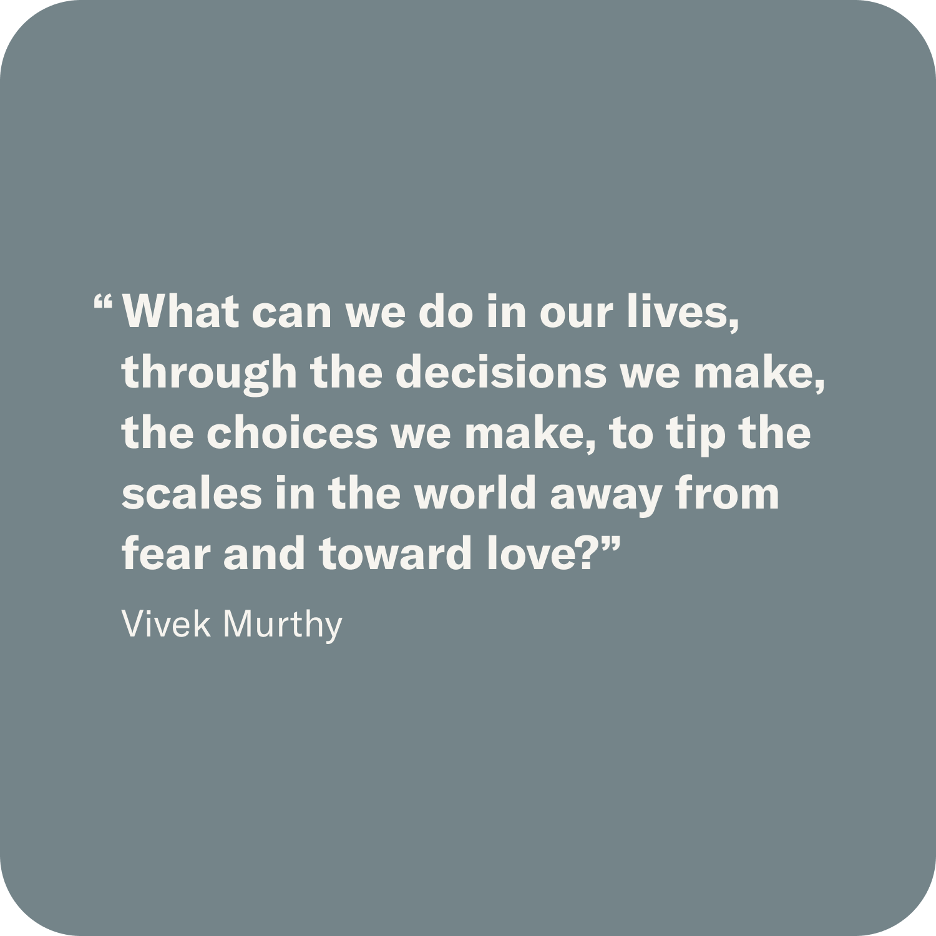
“Violence is what happens when we don’t know what else to do with our suffering.” -Parker Palmer
“But no matter the medicinal virtues of being a true friend or sustaining a long close relationship with another, the ultimate touchstone of friendship is not improvement, neither of the other nor of the self, the ultimate touchstone is witness, the privilege of having been seen by someone and the equal privilege of being granted the sight of the essence of another, to have walked with them and to have believed in them, and sometimes just to have accompanied them for however brief a span, on a journey impossible to accomplish alone.” – David Whyte, Consolations – Revised edition: The Solace, Nourishment and Underlying Meaning of Everyday Words
“We are going to hit some turbulence ahead,” [my flying instructor] went on, “and you will learn something about your airplane…. If you tighten your grip on the yoke, you reduce the aerodynamics of your aircraft. You, as the pilot, actually make the flight less safe, steady, and stable. So, remember: When the going gets rough, fly loose…We must resist looking to the frameworks of the past to lead us into the future. Doing so is a way to pretend to control, to tighten our grip and reduce our cultural aerodynamic flexibility. Instead, perhaps we turn to ways of wisdom that cultivate intuition, patience, and ingenuity. We embrace the ways of a Mystic Wayfinder, one who purposefully gets lost in order to chart new ways forward. By getting lost and welcoming the reality that we do not have the answers or know the way forward, we enter a space of liminality and emergence. We are not attempting to fix “broken systems” but are, instead, summoning entirely new worlds…. We do not have the answers today. We have the wondering. -Rev. Cameron Trimble, via Center for Action and Contemplation
“I am aware that we do not save each other very often. But I am also aware that we save each other some of the time.” – James Baldwin
Tenderness is spontaneous and disinterested; it goes far beyond empathetic fellow feeling. Instead it is the conscious, though perhaps slightly melancholy, common sharing of fate. Tenderness is deep emotional concern about another being, its fragility, its unique nature, and its lack of immunity to suffering and the effects of time. Tenderness perceives the bonds that connect us, the similarities and sameness between us. It is a way of looking that shows the world as being alive, living, interconnected, cooperating with, and codependent on itself. – Olga Tokarczuk (via The Marginalian)
“Wonder is where it starts, and though wonder is also where it ends, this is no futile path. Whether admiring a patch of moss, a crystal, flower, or golden beetle, a sky full of clouds, a sea with the serene, vast sigh of its swells, or a butterfly wing with its arrangement of crystalline ribs, contours, and the vibrant bezel of its edges, the diverse scripts and ornamentations of its markings, and the infinite, sweet, delightfully inspired transitions and shadings of its colors — whenever I experience part of nature, whether with my eyes or another of the five senses, whenever I feel drawn in, enchanted, opening myself momentarily to its existence and epiphanies, that very moment allows me to forget the avaricious, blind world of human need, and rather than thinking or issuing orders, rather than acquiring or exploiting, fighting or organizing, all I do in that moment is “wonder,” like Goethe, and not only does this wonderment establish my brotherhood with him, other poets, and sages, it also makes me a brother to those wondrous things I behold and experience as the living world: butterflies and moths, beetles, clouds, rivers and mountains, because while wandering down the path of wonder, I briefly escape the world of separation and enter the world of unity.” – Hermann Hesse (via The Marginalian)
“Plants do not speak, but their silence is alive with change.”― May Sarton, Plant Dreaming Deep
“No experience has been too unimportant, and the smallest event unfolds like a fate, and fate itself is like a wonderful, wide fabric in which every thread is guided by an infinitely tender hand and laid alongside another thread and is held and supported by a hundred others”― Rainer Maria Rilke
“I cannot pretend I am without fear. But my predominant feeling is one of gratitude. I have loved and been loved; I have been given much and I have given something in return; I have read and traveled and thought and written. I have had an intercourse with the world, the special intercourse of writers and readers. Above all, I have been a sentient being, a thinking animal, on this beautiful planet, and that in itself has been an enormous privilege and adventure.” – Oliver Sacks
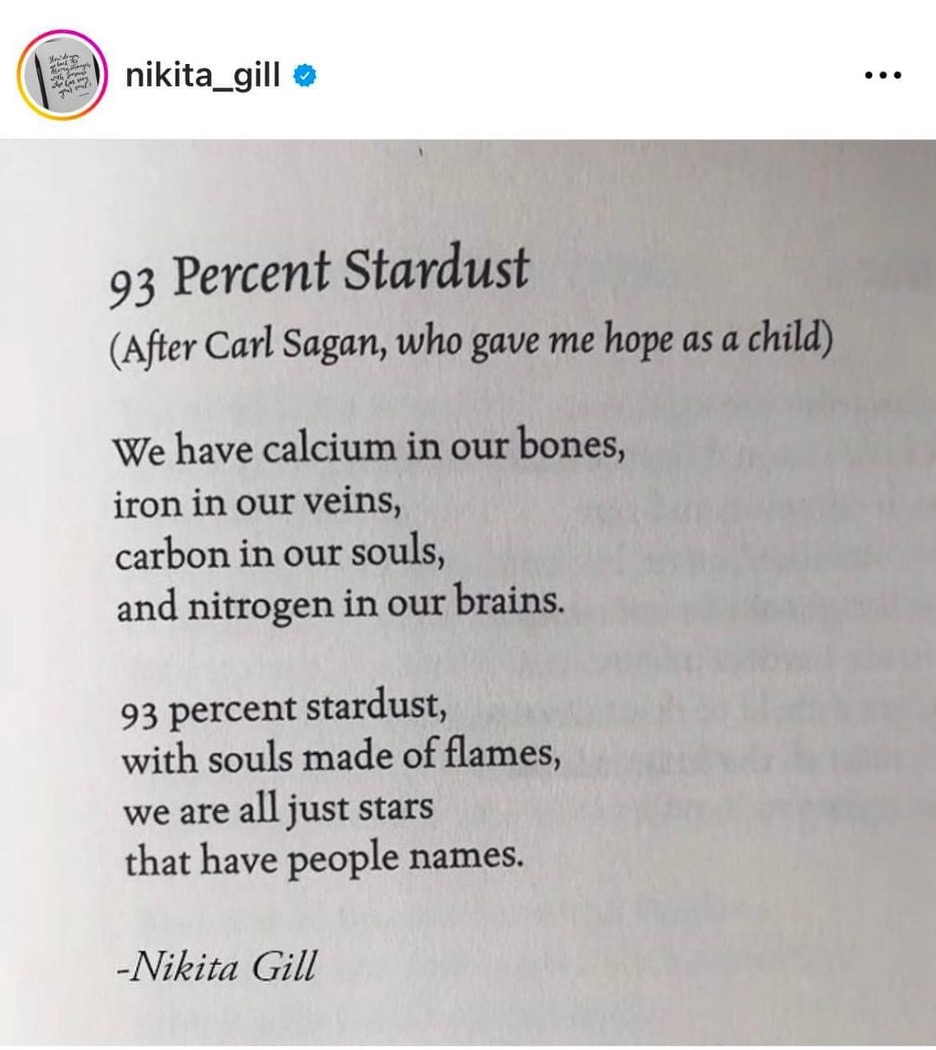

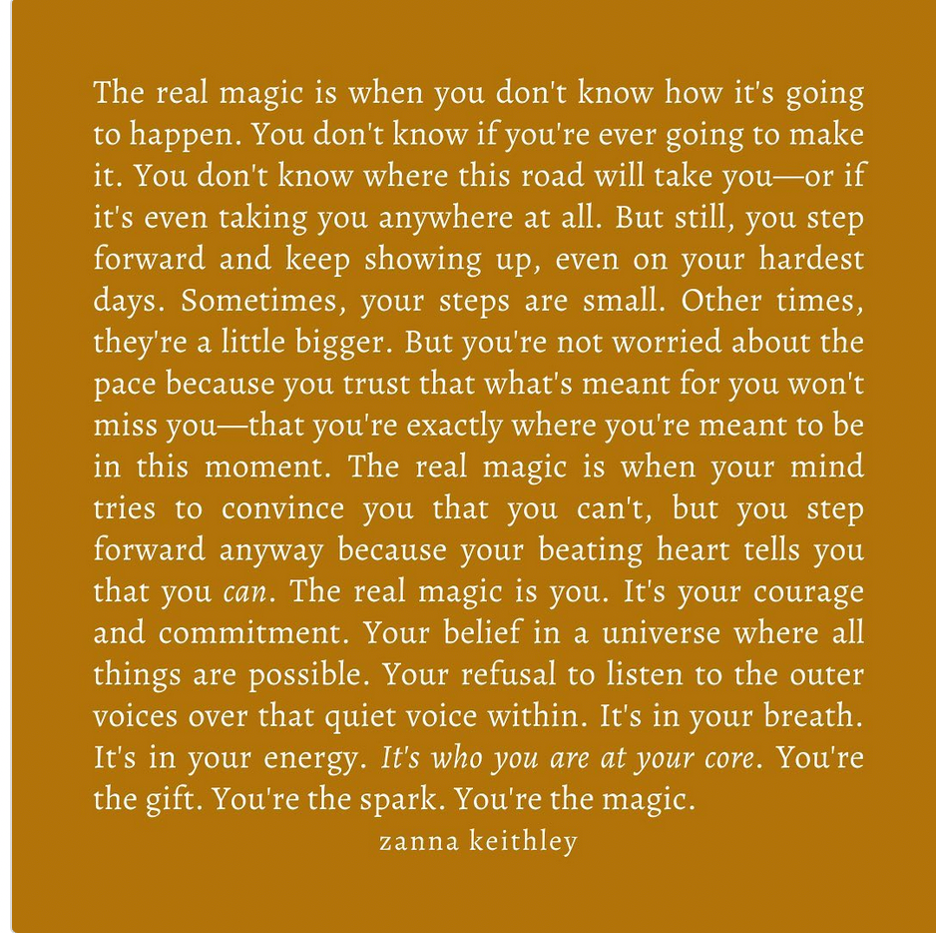
“The scenery of the ocean, however sublime in vast expanse, seems far less beautiful to us dry-shod animals than that of the land seen only in comparatively small patches; but when we contemplate the whole globe as one great dewdrop, striped and dotted with continents and islands, flying through space with other stars all singing and shining together as one, the whole universe appears as an infinite storm of beauty.” -John Muir
“All paths lead to the same goal: to convey to others what we are. And we must pass through solitude and difficulty, isolation and silence in order to reach forth to the enchanted place where we can dance our clumsy dance.” -Pablo Neruda
“Gratitude is not a passive response to something we have been given, gratitude arises from paying attention, from being awake in the presence of everything that lives within and without us. Gratitude is the understanding that many millions of things come together and mesh together in order for us to take even one more breath of air, that the underlying gift of life and incarnation as a living, participating, human being is a privilege; that we are miraculously, part of something, rather than nothing.” -David Whyte “Consolations: The Solace, Nourishment and Underlying Meaning of Everyday Words”
“The transformation of the heart is a wondrous thing, no matter how you land there.” -Patti Smith
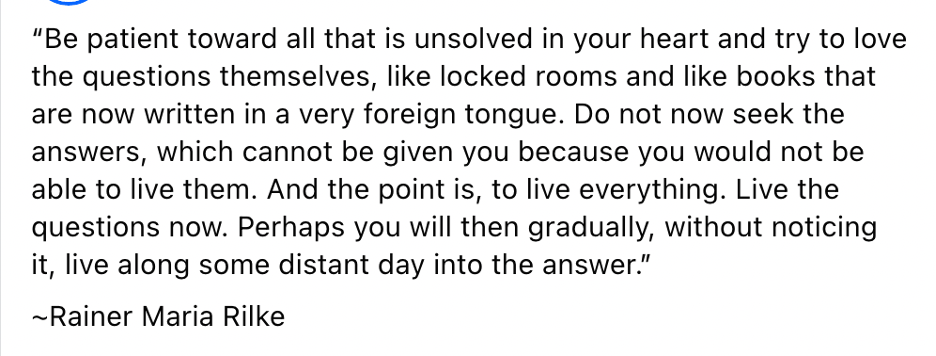
Truly, we live with mysteries too marvelous
to be understood.
How grass can be nourishing in the
mouths of the lambs.
How rivers and stones are forever
in allegiance with gravity
while we ourselves dream of rising.
How two hands touch and the bonds will
never be broken.
How people come, from delight or the
scars of damage,
to the comfort of a poem.
Let me keep my distance, always, from those
who think they have the answers.
Let me keep company always with those who say
“Look!” and laugh in astonishment,
and bow their heads. ~Mary Oliver
Forever grateful for this word journey and am ready for more! Happy New Year!
-A
Tagged: 2023, Inspiration, Life, Maria Popova, On Being, poetry, The Marginalian, words, writing
 foodrevival
So many words! I’ll choose: lovely
Perfect word because that’s what you are. xoxoxoxoxox